CONNECTED STEERING TEST BENCH FOR DEMANDING DEVELOPMENT TASKS IN THE LAB AND ON DRIVING SIMULATORS - Validation of the V-model in real tests
MXsteerLink: seamless transition between MiL/SiL and HiL
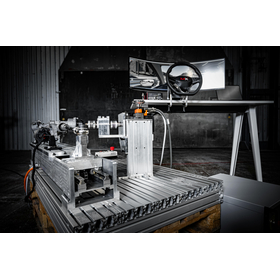
MXsteerLink links our MXsteerHiL steering test bench with the MXsteerWheel RTpro steering force feedback unit. High-precision steering angles and steering torques are exchanged in real time, latency-free and in very fast cycles. This combination is essential for an authentic steering feel in applications both in the lab and on dynamic driving simulators. In coupled MiL/SiL and HiL mode, complete steering systems and steering-related functions can be made tangible for development engineers without a mechanical steering column connection – and without the need to install of the entire steering system in the cockpit. Sophisticated use cases such as steering tests, tire tests, ADAS functions and much more can be mapped.
Mapping a real steering feel in early development is an enormous challenge for engineers. Be it on the MiL/SiL or HiL test bench. In particular, the comparability between HiL and SiL applications, especially with regard to parameterization and validation of the steering models and ECU functions, involves a great deal of effort. Inadequate model mapping, complex parameterization, undesirable effects, errors or problems with the hardware are often detected too late in the development process today, so that reacting to them involves considerable effort, time and costs. In addition, dynamic driving simulators have space and weight problems when it comes to incorporating real steering.
The MXsteerLink environment enables end-to-end support of the validation process in every phase of the V-model. Whether as a pure MiL/SiL test bench, as HiL with real steering hardware or as a driver-in-the-loop solution for dynamic driving simulators. This also applies to steer-by-wire applications. Coupling a force-feedback steering wheel (MXsteerWheel RTpro) with an MXsteerAct without any mechanical connection makes it possible to experience the steering feel independently of the environment. For dynamic driving simulators, only the force feedback steering wheel needs to be integrated into the simulator, while the HiL can be positioned in a different room. The connection between the test bench and the force feedback unit is made via cables, which can be integrated in any length according to customer requirements.
EtherCAT communication offers a universal interface for existing real-time systems at the customer.







![[Case Study] Optimization of a daylighting device that delivers sunlight deep into the room.](https://image.mono.ipros.com/public/product/image/709/2000430152/IPROS8097904568024191048.jpg?w=280&h=280)